Resolving CON-412: Instrument Not Valid in FIRDS Reference Data
Key Takeaways
- Rejection Concentration: CON-412 remains a dominant MiFID rejection driver, showing that instrument-reference-data validation is still a core weakness across reporting operations.
- Two Primary Causes: The error usually means either the instrument is absent from FIRDS entirely or venue-specific reference data was missing on the trade date.
- Trade-Date Sensitivity: Reportability must be checked by historical trade date, not assumed from present-day FIRDS status, especially when resolving older rejected submissions.
- Venue Logic Importance: The distinction between XOFF and XXXX depends on venue admission and regional reportability, making venue population central to avoiding false submissions.
- Preventive Discipline: Due diligence on reportability before submission is framed as the most effective way to avoid repeated CON-412 remediation cycles.
CON-412 means the instrument was not valid in FIRDS reference data on the transaction date. This guide explains the two most common causes (instrument missing from FIRDS, or venue/date reference data missing), how to validate UK/EU reportability by trade date, and the operational steps to resolve rejections and prevent repeat errors.
According to the FCA, nearly 60pct of rejected transactions are due to the instrument not being found in their Financial Instruments Reference Data System (FIRDS) database.
MiFID firms submitting transaction reports will be familiar with the CON-412 rejection code the error code assigned by ESMA, the originators of the MiFID body of regulations. The CON-412 error states: Instrument is not valid in reference data on transaction date and is well-known amongst regulatory operational specialists monitoring transaction reports.
The CON-412 error is received when the report falls under one of the two scenarios:
- The instrument is not present in the FIRDs reference data
- There is no reference data, in FIRDS, for that instrument from the venue reported on the trade date
Even though firms have had over six years to embed processes, the CON-412 rejection code continues to be a pain point for operations and compliance departments. In 2018, at the start of MiFID, over 37pct of rejections were due to this error. In 2019, this skyrocketed to nearly 70pct of rejected transactions being assigned this error only to drop back down to over 57pct in 2020.
How do firms avoid or resolve this issue? The first port of call would be to conduct due diligence in ensuring the transaction is reportable and present in FIRDS.
The free MiFID Reportability tool by Qomply can help. The cloud-based tool retrieves instrument data across all UK and EU trading venues and instantly confirms whether an instrument is reportable on a specific date. If the instrument is not reportable, and there are no underlying instruments, then the transaction should not be submitted to the regulator as it would be considered over reporting.
Step 1: Search Instrument in FCA and EU FIRDS
Access the Tool
https://qti.qomplypi.com/firdslookup
Enter ISIN to Check Across UK and EU Databases
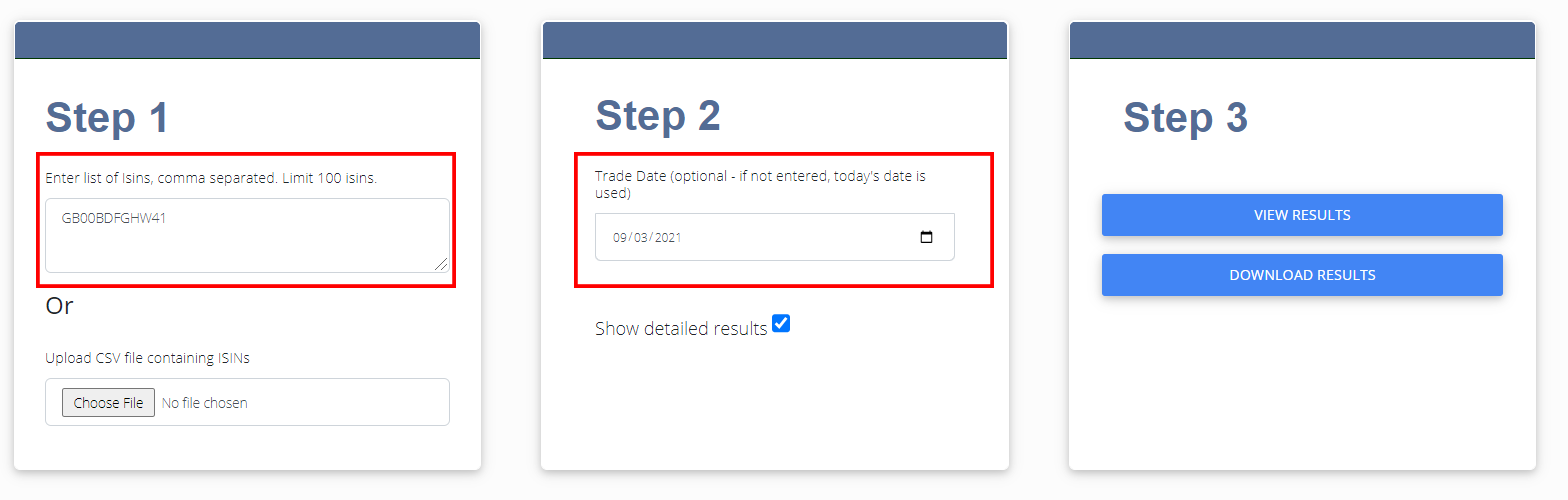
In our test, we use ISIN GB00BDFGHW41
Click View Results
The Trading Venues on which this instrument was tradable for todays date are shown.
Determine Reportability
To determine if a particular instrument was considered reportable on a trade date, enter the ISIN and the Trade Date in Step 2 on the screen. If a date is not entered, the system will retrieve data for today.
The results show whether the instrument is reportable in the UK and/or reportable in the EU alongside the Trading Venue on which it was active.
Additional details such as the Trading Venue, to which the instrument was admitted, also appears. For firms who traded the instrument on a trading venue this is useful. If you traded the instrument on a trading venue and it is not listed in the results, then contact the trading venue to ensure they submitted the reference data to FIRDS an obligation they have under RTS23 of MiFIR.
If an instrument is traded XOFF (field 36 venue of the transaction report), then the instrument should be reportable on at least one trading venue in the region.
If an instrument is traded XXXX (field 36 venue of the transaction report), then the instrument should not have been admitted to trading in the region. That is, using the example above, in column Reportable in the UK we should not see TRUE in any of the rows.
Step 2: Advanced Tips and Tricks
Get Results for a Specific Trade Date
This feature is especially useful when troubleshooting historic transaction reports.
To go back in time to a specific trade date to determine reportability on that date, enter the ISIN, enter a trade date, and click VIEW RESULTS.
Get Results for Multiple ISINs
To conduct efficient searches across multiple ISINS for the same trade date, simply enter a series of ISINS separated by a comma. Enter the trade date and click VIEW RESULTS.
Get Results for Multiple ISINs in a CSV file
From page https://qti.qomplypi.com/firdslookup, select the CSV file from your local machine, enter a trade date and click VIEW RESULTS.
Download Results
Instead of viewing the results on the screen, it may be more helpful to download the results to a CSV file. This is especially true when entering more than one ISIN. Run the search as normal however instead of clicking VIEW RESULTS, click DOWNLOAD RESULTS.
How Qomply can help
FIRDS Lookup: MiFID Reportability Tool: Quickly confirm MiFID reportability for any instrument and trade date with historical FCA and ESMA FIRDS data. Qomply's FIRDS Lookup Tool is the only freely available tool that queries both FCA and ESMA databases.
Frequently asked questions
It means the instrument was not valid in FIRDS reference data on the transaction date. The article says this is one of the most common MiFID rejection reasons.
The two main causes are that the instrument is missing from FIRDS or that there is no venue reference data in FIRDS for that instrument on the trade date. The article says firms need to test both scenarios when troubleshooting.
It describes it that way because the rejection has remained highly prevalent since MiFID go-live. The article says it accounted for over 37% of rejections in 2018, nearly 70% in 2019, and over 57% in 2020.
It says XOFF trades should involve an instrument reportable on at least one venue in the region, while XXXX trades should not involve an instrument admitted to trading in that region. The article presents that distinction as a practical troubleshooting test.
They should perform reportability due diligence against UK and EU FIRDS by ISIN and trade date before resubmitting. The article says firms should not send a transaction to the regulator if the instrument is not reportable and has no underlying bringing it into scope.
Purpose-built solutions and services for regulatory reporting
Designed to improve accuracy, reduce risk, and support confident transaction reporting.