Explore our insights

 Insights
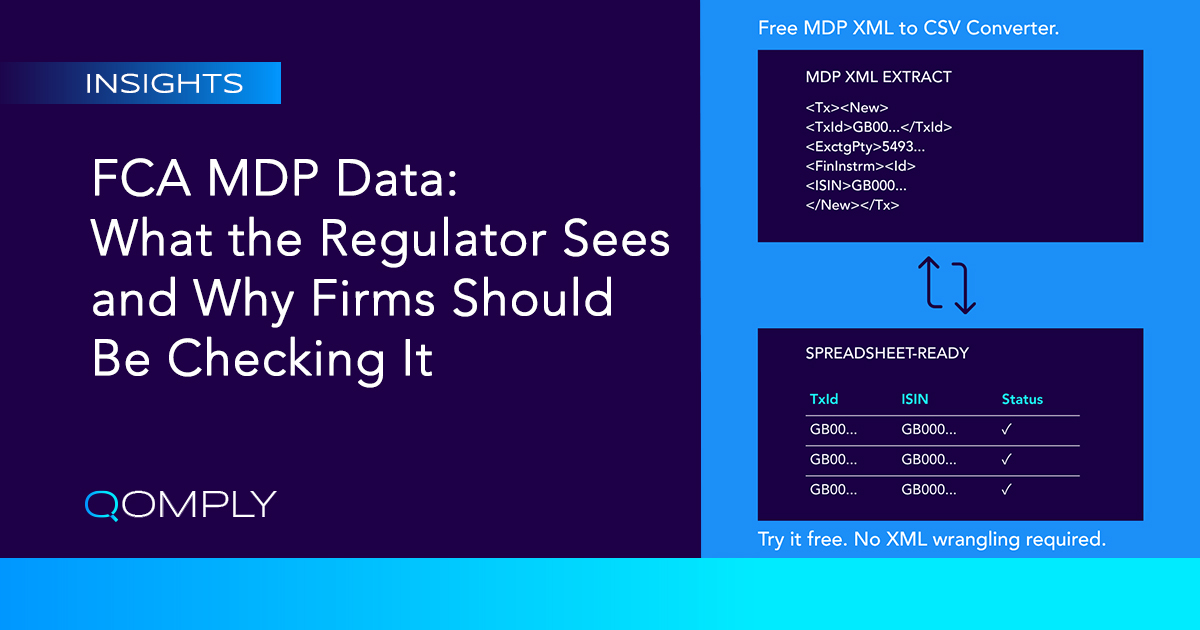
FCA MDP Data: What the Regulator Sees and Why Firms Should Be Checking It
Learn why firms should review FCA MDP transaction reporting data and how converting XML extracts to CSV makes reconciliation and analysis easier.
 Insights
PS26/15 Is Here: What Firms Should Really Take Away From the FCA’s Final MiFIR Transaction Reporting Reforms
Explore what FCA PS26/15 means for UK MiFIR transaction reporting, from reportability and data sourcing to implementation ahead of 3 April 2028.
 Insights
From Submission to Assurance: The Path to Proving Transaction Reporting Accuracy.
Learn how regulators across G20 regimes expect firms to reconcile transaction reports, identify reporting breaks and evidence accurate regulatory data.
 Insights
ESMA's "Report Once" Vision Moves Closer: What the Final Report Means for Transaction Reporting
ESMA’s Final Report sets out a Report Once framework across MiFIR, EMIR and SFTR. Explore the savings, timeline and actions firms should take.
 Insights
Beyond ESMA: (Part 2) What the Interim Report Means for Global Reporting
Learn how ESMA and FCA reforms are shaping global transaction reporting strategies through harmonisation, stronger data governance and resilience.
 Insights
ESMA's Interim Report (Part 1): Why 'Report Once' Matters More Than Ever
Discover how ESMA's Report Once initiative could reduce transaction reporting complexity through greater harmonisation, interoperability and data quality.
 Insights
ESMA’s New MiFIR Data Quality Framework
Understand the impact of ESMA's New MiFIR Article 26 Data Quality Engagement Framework and what firms must do to improve reporting quality.
 Insights
ASIC Demands Stronger Reporting Controls
ASIC REP 828 revealed 70 million erroneous CFD reports, highlighting failures in delegated reporting, reconciliation and reporting governance.
 Insights
HKMA Releases Updated Validation Rules in Response to Common Data Quality Issues
HKMA and HKTR have updated ISO 20022 validation rules to address data quality issues, strengthen UPI & OTC derivatives reporting from 21 November 2026.
 Insights
Common Data Issues: Why Excel Causes Issues with CSV Files in Regulatory Submissions
Learn how CSV formatting issues in Excel cause rejected regulatory submissions, reconciliation breaks and data validation failures, and how firms can fix this.
 Insights
Why Technology is Redefining Transaction Reporting Reconciliations
Discover how modern technology is redefining transaction reporting reconciliations with real-time matching, anomaly detection and improved regulatory oversight.
 Insights
Global Transaction Reporting Rewrites Are Forcing Industry Modernisation
Global transaction reporting rewrites across APAC, Europe and North America are driving standardisation, automation and demand for scalable reporting solutions.
 Insights
ASIC Transaction Reporting: The 30-Day Reconciliation Blind Spots
ASIC’s 30-day reconciliation rule under RG 251 is often missed, creating blind spots in reporting. Learn how to detect errors, open positions, and reduce risk.
 Insights
The UK MiFID Rewrite: FCA Predicts Savings. Industry Remains Skeptical
The FCA's CP25/32 UK MiFID rewrite promises 25% transaction reporting savings. Qomply poll shows firms are skeptical due to change, IT and interpretation costs.
 Insights
Common Regulatory Reporting Failures Across Regions
Across CFTC, FCA, ASIC, CSA, MAS and HKMA/HKTR, regulators repeatedly flag the same reporting failures: missing submissions, inaccurate data, late reporting.
 Insights
FCA MiFIR Fines Explained: Lessons From Recent Transaction Reporting Enforcement
Former FCA regulator Sophia Fulugunya explains FCA's recent MiFIR transaction reporting finesand practical lessons compliance teams must act on.
 Insights
Qomply Survey 2026: 90% Support FCA MiFID Reform (CP25/32)
Qomply's 2026 industry survey reveals that 90% of firms expect the FCA's proposed UK MiFID transaction reporting reforms (CP25/32) to reduce reporting costs.
 Insights
CFTC Dead Swap Relief Impact on Firms: Relieves Burden, Shifts Focus to Data Quality & Reconciliation
CFTC dead swap relief reduces historical corrections, but scrutiny is shifting to open swaps and recent data quality. Learn why reconciliation matters.
 Insights
Silent Errors in MiFID Transaction Reports: Why Reconciliation Matters
MiFID transaction report reconciliation guidance: how to detect silent errors, validate completeness and accuracy, and meet FCA expectations under MiFIR RTS 22.
 Insights
FCA CP25/32: Proposed Changes to UK MiFID Transaction Reporting
Summary of FCA CP25/32 proposals to reform UK MiFID transaction reporting: scope changes, reduced back-reporting, and simplified derivatives reporting.
 Insights
Key Takeaways From FCA Market Watch 84: UK EMIR Refit One Year On
FCA Market Watch 84 is the first Market Watch dedicated to UK EMIR Refit. Key takeaways one year after go-live: governance, third-party oversight, breach.
 Insights
The Future of Trade & Transaction Reporting | Key Takeaways From the Panel Discussion
Key takeaways from Qomply, ISDA & IA panel on future of transaction reporting, covering data-driven regulation, divergence, RegTech, and enforcement trends.
 Insights
EMIR Refit: ESMA Data Quality Report - Key Messages and Findings
ESMA's EMIR Refit data quality report highlights persistent issues across outstanding trades, outstanding positions, missing valuations and outdated.
 Insights
Governance Matters: FCA’s Latest Warning in Market Watch 83
FCA Market Watch 83 highlights governance weaknesses such as unclear accountability, ineffective systems and controls, insufficient training, weak escalation.
 Insights
FCA Market Watch 82: Key Takeaways for MiFID Transaction Reporting
Key takeaways from FCA Market Watch 82: expectations for remedial timelines, back reporting of errors, and high-quality errors & omissions notifications.
 Insights
FCA Issues MiFIR Fine to Sigma Broking for £1.087m
The FCA fined Sigma Broking £1.1m for nearly one million inaccurate MiFIR transaction reports. Learn what went wrong and the key compliance lessons for firms.
 Insights
FCA Strategy 2025–2030: What “Being a Smarter Regulator” Really Means for Firms
The FCA Strategy 2025–2030 signals a shift to a more proactive, data-led regulator. Learn the key priorities and what firms must do to strengthen governance, controls and compliance frameworks
 Insights
FCA Strategy 2025–2030: the FCA's Balancing Act on Growth
Recently, the FCA released their Strategy 2025 – 2030 publication and this article explores its 'Supporting Growth' priority.
 Insights
When AI Fails & Why Compliance Still Needs Human Expertise
The risks of relying on AI in regulatory compliance and why human expertise remains essential to ensure accuracy, accountability, and effective risk management.
 Insights
FCA Issues First UK MiFIR (RTS 22) Fine for Transaction Reporting Failures
The FCA’s first MiFIR fine highlights the risks of poor transaction reporting, weak controls, and failure to self-report. Key lessons for compliance teams.
 Insights
EMIR Refit: Reporting Underlying Assets: Reference Entities vs Underlying Identifiers
Mis-population of the underlying identification fields versus the reference entity field is a common driver of TR rejects and reconciliation breaks.
 Insights
Avoiding Common Pitfalls in Reporting OTC Transactions for SI-Traded Instruments
Avoid common MiFIR OTC transaction reporting pitfalls for SI-traded instruments. Learn how to improve FIRDS checks, validate ToTV underlying, and prevent.
 Insights
MiFID II Compliance: Same Buyer and Seller Reporting Explained
Learn when the same buyer and seller can appear in MiFID transaction reports, including delegated discretionary mandates.
 Insights
ESMA MiFIR Review: Key Proposals & Dates
ESMA has issued its fourth MiFIR Review consultation package with a focus on amended RTS 22 transaction reporting.
 Insights
Top EMIR Refit Rejections
Qomply shares the top rejections for EMIR Refit in the UK. Unsurprisingly, many of these rejections are associated with lifecycle events.
 Insights
Insights: ESMA Announces Changes to MiFID Transaction Reporting
Last week, ESMA formally announced significant revisions to the MiFIR reporting framework that will impact MIFID investment firms.
 Insights
MiFID II INTC Aggregated Client Account Reporting
INTC is the MiFID II convention for reporting aggregated client orders. Learn regulator expectations, common allocation mistakes, and validation controls to.
 Insights
MiFID II: Direct Transaction Reporting to the FCA FAQs
FAQs on reporting MiFID II transaction reports directly to the FCA (instead of using an ARM): eligibility under MiFIR Article 26(7), costs, controls.
 Insights
MiFID Back Reporting Remediation: ARM vs Direct Reporting Guide
Compare MiFID back-reporting remediation options, incl. ARM providers and direct reporting, to reduce costs, improve efficiency, and manage risk effectively.
 Insights
MiFID Transaction Reporting Governance: Traceability & Accountability
Good transaction reporting governance depends on accountability and traceability.
 Insights
MiFID Price & Quantity Notation: Prevent Market Watch 74 Silent Errors
Learn how incorrect price and quantity notation creates silent MiFID reporting errors under FCA MarketWatch 74, and how to improve data quality.
 Insights
EMIR Refit: TONA Index Recognition - UK FCA Vs EU ESMA Validation Differences
Understand how TONA is treated under EMIR Refit in the UK vs EU. Learn key validation differences, impacted fields, and how to avoid reporting errors.
 Insights
EMIR Refit Gotcha: Use MIC Codes for Third-Country Venues (Not XOFF)
Under EMIR Refit, OTC trades on third-country venues still require MIC codes, not XOFF. Learn the rule, avoid validation errors, and fix reporting logic.
 Insights
EMIR Refit Report Tracking Number: Timeliness & Best Practice
EMIR Refit RTNs (Report Tracking Numbers) are execution-level identifiers disseminated by venues. Learn RTN timeliness expectations, when
 Insights
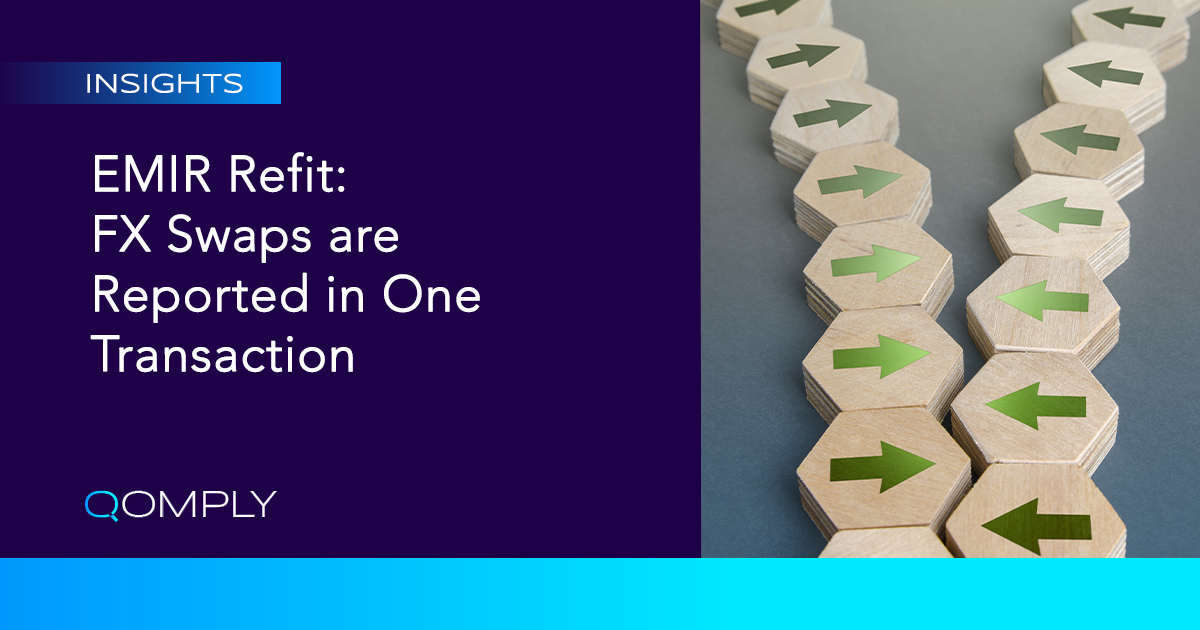
EMIR Refit Reporting: FX Swaps Should Be Reported As One Transaction
FX swaps must be reported as a single trade under EMIR Refit, not split like MiFIR. Avoid data breaks, rejects, and reconciliation issues with correct logic.
 Insights
MiFID MDP XML to CSV File Converter
Free MiFID MDP XML to CSV converter. Turn regulator MDP XML output into spreadsheet-ready CSV in seconds to support review, QA and investigations.
 Insights
EMIR Refit Gotcha: Client Codes Should Not Contain Personal Data
Under EMIR Refit, client codes must be unique to the reporting counterparty and must not contain personal data.
 Insights
EMIR Refit: Top 5 Challenges for Regulated Firms
EMIR Refit increases reporting scope, introduces new XML workflows and expands reconciliation requirements.
 Insights
Five Reasons to Reconcile MiFID Transaction Reports
Five reasons to reconcile MiFID transaction reports: meet RTS 22 obligations, detect over- and under-reporting, improve controls, and prevent recurring data.
 Insights
MiFID Client Static Data Mapping | Prevent Silent Errors in MiFID
Client static data mapping errors can create silent MiFID reporting issues, including incorrect LEIs, mismapped entities, and lapsed identifiers.
 Insights
MiFID Trading Time Precision: Milliseconds Vs Microseconds | Prevent Silent Errors in MiFID
MiFID transaction reporting guidance on trading time precision. Learn when to report in microseconds vs milliseconds vs seconds, and how incorrect granularity.
 Insights
MiFID Duplicate Trades: When Transaction IDs Create Silent Errors
Duplicate trades in MiFID reporting can occur even with unique transaction IDs. Learn the causes and how to detect and prevent these silent errors.
 Insights
MiFID Late Submissions | Prevent Silent Errors in MiFID
How MiFID transaction reports slip past T+1 deadlines on bank holidays and during staff leave.
 Insights
MiFID Block Vs Fill Reporting: FCA Market Watch Expectations
A practical guide to MiFID block vs fill reporting. Align with FCA Market Watch expectations and ensure accurate transaction reporting decisions.
 Insights
MiFID TVTIC Data Quality: Structure and Validity (RTS 22 Field 3)
A practical guide to MiFID TVTIC Field 3. Improve structure validity, meet regulatory checks, and reduce transaction reporting errors.
 Insights
MiFID Internal Allocations (INTC) & Block Trades: Troubleshooting Guide
A practical guide to MiFID INTC reporting and block trades. Understand allocation rules, avoid common breaks, and improve reconciliation accuracy.
 Insights
MiFID Field 28: Trading Date/Time for Corporate Actions and Corporate Events
A practical guide to MiFID Field 28 reporting. Understand corporate event timing, ESMA expectations, and how to avoid common transaction reporting mistakes
 Insights
MiFID Country Fields (Fields 37, 8, 17, 58, 60): Avoid Common Reporting Pitfalls
A practical guide to MiFID country fields. Get Fields 37, 8, 17, 58 and 60 right with clear rules, examples, and common pitfalls explained.
 Insights
MiFID XXXX Vs XOFF for OTC Trades: RTS 22 Trading Venue Guide
Step-by-step guide to populate the MiFID ‘Trading Venue’ field for OTC trades: when to use XOFF vs XXXX under RTS 22 (UK FCA vs EU NCA), with practical.
 Insights
Resolving CON-412: Instrument Not Valid in FIRDS Reference Data
What does the MiFID CON-412 FIRDS error means, why it occurs when an ISIN is missing from reference data, and how firms can troubleshoot reportability.
 Insights
Important Findings From FCA Market Watches 59, 62 and 65
Discover key findings from FCA Market Watch 59, 62 and 65, including common MiFID reporting failures in controls, data quality, and reconciliation.
 Insights
Key Takeaways from FCA Market Watch 65
Key findings from FCA Market Watch 65. Learn how firms misinterpret MiFID reportability, misuse FIRDS data, and where controls commonly fail.
 Insights
The Importance of Reconciling and Auditing Transactions
Learn why MiFID II transaction report reconciliation and auditing matter, how FCA scrutiny exposes reporting gaps, and what firms must do to stay compliant.
No resources found. Try adjusting your filters or search term.