What is EMIR Refit Transaction Reporting?
EMIR Refit (European Market Infrastructure Regulation Refit) is the mandatory regulatory update to the existing EMIR transaction reporting rules, which requires financial firms to report their over-the-counter (OTC) derivatives transactions in the EEA (European Economic Area).
ESMA published their 2024 Report on Quality and Use of Data on Data Quality on 30 April 2025, which provided an idea of progress a year on from implementation. In summary, data quality has improved with most metrics recording drops in breaches or exceptions – although ESMA notes there is still progress to be made. The FCA has not released a similar report.

About EMIR Refit Transaction Reporting
The European Market Infrastructure Regulation (EMIR) covers derivatives, central counterparties and trade repositories (TRs) and was initially adopted in 2012. The amended version, EMIR Refit, was adopted in 2019. Following Brexit, there are now UK EMIR and EU EMIR regulations. The new rules under EMIR Refit came into effect on 29 April 2024 for EU entities and 30 September 2024 for UK entities.
The publication of the EMIR Refit changes supported the main purpose of the original EMIR, which was to reduce systemic, counterparty and operational risk whilst increasing transparency in the OTC derivatives market. It also aimed to improve the data quality received by regulators, provide clarity to firms where required, and streamline the registration process for TRs.
Who will be primarily affected under 2024 EMIR Refit?
- Counterparties in scope of the reporting requirements under EMIR Refit
- TRs registered, or recognised, under EMIR Refit
- Third party service providers who offer reporting services to counterparties subject to reporting under EMIR Refit
What are the changes under 2024 EMIR Refit?
- More reporting fields: Increase in the number of reportable fields from 129 to 203. A small number of fields have been removed, such as “Trade capacity”.
- Change in reporting format from CSV to XML: ISO20022 standard, the open global standard for financial information, requires EMIR reports to follow standardised XML structure.
- Unique Trade Identifier (UTI): For derivatives reports concluded after the effective date, a specific UTI code will be used to update the state of these reports.
- Unique Product Identifier (UPI): UPI will be required to report most derivatives trades and must be present in the Derivatives Service Bureau (DSB) database.
When Reporting Goes Wrong
Regulatory reporting failures continue to result in fines, investigations and remediation programmes across multiple jurisdictions.
RECENT ENFORCEMENT ACTIONS:
-
ESMA sanctions REGIS-TR for serious breaches of organisational obligations
ESMA – (Press release, 19 Feb 2026) -
Enforcement Action: GlobalReach Multi-Strategy ICAV fined €192,500 and reprimanded by the Central Bank of Ireland for breach of its reporting obligation under EMIR
Central Bank of Ireland – (Press release, 30 Nov 2023)
Avoid the cost of getting it wrong. Get it right first time with Qomply.
Rely On Qomply To Help










Start your
Qomply journey
Related Resources

 Guides
EMIR Refit Guide: Lessons Learned from EU Go Live

EMIR Refit Transaction Reporting Foundation Training
 Insights
Key Takeaways From FCA Market Watch 84: UK EMIR Refit One Year On
 Videos
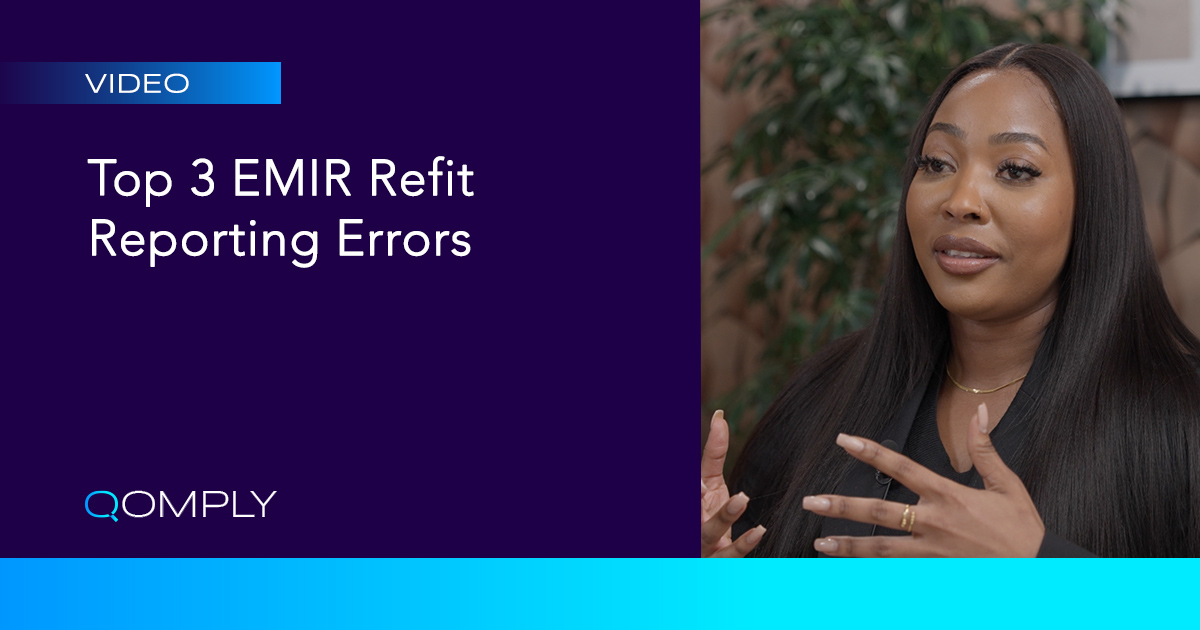
Top 3 EMIR Refit Transaction Reporting Mistakes
 Insights
EMIR Refit: ESMA Data Quality Report - Key Messages and Findings
 Insights
EMIR Refit: Reporting Underlying Assets: Reference Entities vs Underlying Identifiers
 Videos
EMIR Refit 101: What is EMIR Refit Transaction Reporting?
FAQs: EMIR Refit Transaction Reporting
EMIR Refit transaction reporting covers all derivate contracts, regardless of whether they are OTC derivatives or exchange-traded derivatives. Subject to certain exceptions, both sides of the trade report data that must be matched in a TR.
Unlike most transaction reporting regimes, EMIR Refit reporting is double-sided. This means that each counterparty to a derivative trade has a reporting obligation, rather than the reporting counterparty being determined by a reporting hierarchy.
Financial Counterparties (defined by EMIR Article 2(8) as a regulated financial institution, e.g., banks) must report their own transactions, as must Non-Financial Counterparties (NFC) (defined as anything not a Financial Counterparty, e.g., corporates) above the clearing threshold for that particular type of derivative. The clearing threshold figure is based on the gross notional value of outstanding non-hedging OTC derivative contracts across all group entities. Where the clearing threshold is not met, small NFCs do not report and the Financial Counterparty on the other side will report on their behalf. Intra-group trades are exempt from reporting requirements if at least one side of the trade is an NFC and certain other conditions are met.
At a high-level, in addition to seeking to provide higher quality information for regulators, EMIR Refit sought to reduce the obligations and burdens on smaller financial counterparties by introducing a clearing threshold. It has also sought to do this for non-financial corporates, where the clearing threshold is now assessed per asset class, rather than on an all or nothing basis.