ESMA's "Report Once" Vision Moves Closer: What the Final Report Means for Transaction Reporting
Key Takeaways
- ESMA has recommended a long-term, integrated transaction reporting framework based on the principle of reporting common data once across MiFIR, EMIR and SFTR.
- The proposed framework would use common data definitions, standardised identifiers, consistent validation rules and modular extensions for regime-specific requirements.
- ESMA estimates that the reform could deliver annual net savings of between €250 million and €1 billion and reduce recurring reporting costs by approximately 22–24%.
- Implementation will be gradual. ESMA has proposed shorter-term simplifications while the legislative and technical work required for the integrated framework progresses.
- Firms should begin considering how interoperable systems, reusable data and flexible reporting architectures could support future regulatory convergence.
On 2 July 2026, the European Securities and Markets Authority (ESMA) published its Final Report on the Call for Evidence on a Comprehensive Approach for the Simplification of Financial Transaction Reporting, marking an important milestone in the evolution of EU regulatory reporting.
As we discussed in our earlier analysis of ESMA's "Report Once" proposals, the consultation signalled ESMA's ambition to fundamentally rethink how transaction reporting operates across the EU. We also explored the broader strategic implications in our article on developing a global transaction reporting strategy, arguing that firms should increasingly view reporting as an enterprise-wide data capability rather than a collection of individual regulatory obligations.
The Final Report provides the clearest picture yet of how that vision could become reality.
At its core is a simple proposition: reduce duplication, improve data quality and enable firms to report once across MiFIR, EMIR and SFTR.
As ESMA Chair Verena Ross summarised:
"Fragmentation has led to duplication, inconsistent requirements and increased costs for market participants and authorities."
Why ESMA believes reform is necessary
Over the past decade, MiFIR transaction reporting, EMIR derivatives reporting and SFTR securities financing transaction reporting have evolved independently. While each regime serves a distinct supervisory objective, they often require firms to report overlapping information using different data models, validation rules and reporting channels.
The result has been increasing complexity, duplicated effort and rising compliance costs.
ESMA identifies three principal drivers of this burden:
- continual regulatory change across separate reporting regimes;
- duplicate reporting of the same transactions under multiple frameworks; and
- dual-sided reporting under EMIR and SFTR, where counterparties submit separate reports that must subsequently be reconciled.
Rather than improving transparency, this fragmented approach frequently creates operational inefficiencies and data quality issues for both firms and regulators.
What does "Report Once" actually mean?
ESMA's preferred long-term solution is a single modular reporting framework covering MiFIR, EMIR and SFTR.
Instead of producing separate reports for each regime, firms would submit transaction data through a common reporting architecture. Core data elements would be reported once, while regime-specific requirements would be added through modular extensions.
The objective is not simply fewer reports. It is a harmonised regulatory data ecosystem built around:
- common data definitions;
- standardised identifiers;
- consistent validation rules;
- reusable reporting data; and
- improved supervisory oversight.
As highlighted in our earlier article on ESMA's Report Once proposals, this represents a fundamental shift away from regime-specific reporting towards a data-centric supervisory model.
The business case: significant long-term savings
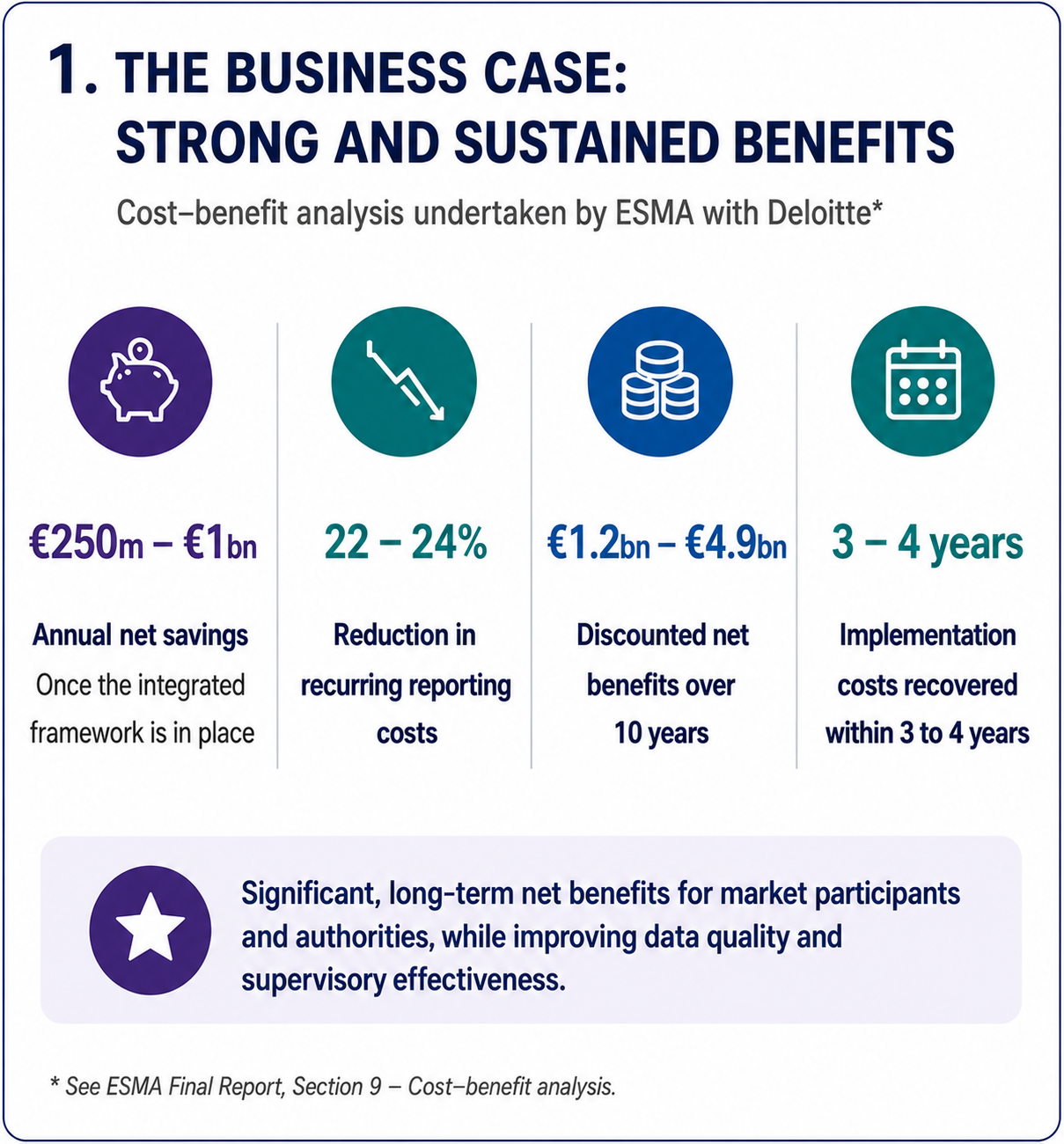
One of the most valuable additions in the Final Report is the publication of ESMA's detailed cost-benefit analysis, undertaken with Deloitte and informed by extensive engagement with market participants.
According to the study, implementation of an integrated reporting framework could deliver:
- €250 million to €1 billion in annual net savings;
- approximately 22–24% lower recurring reporting costs;
- between €1.2 billion and €4.9 billion in discounted net benefits over ten years; and
- recovery of implementation costs within approximately three to four years.
These figures reinforce what many firms have experienced first-hand: maintaining multiple reporting frameworks is becoming increasingly expensive as regulatory requirements continue to evolve independently.
ESMA's projected benefits
Reform will be evolutionary, not immediate
While the vision is ambitious, ESMA is realistic about the implementation timeline.
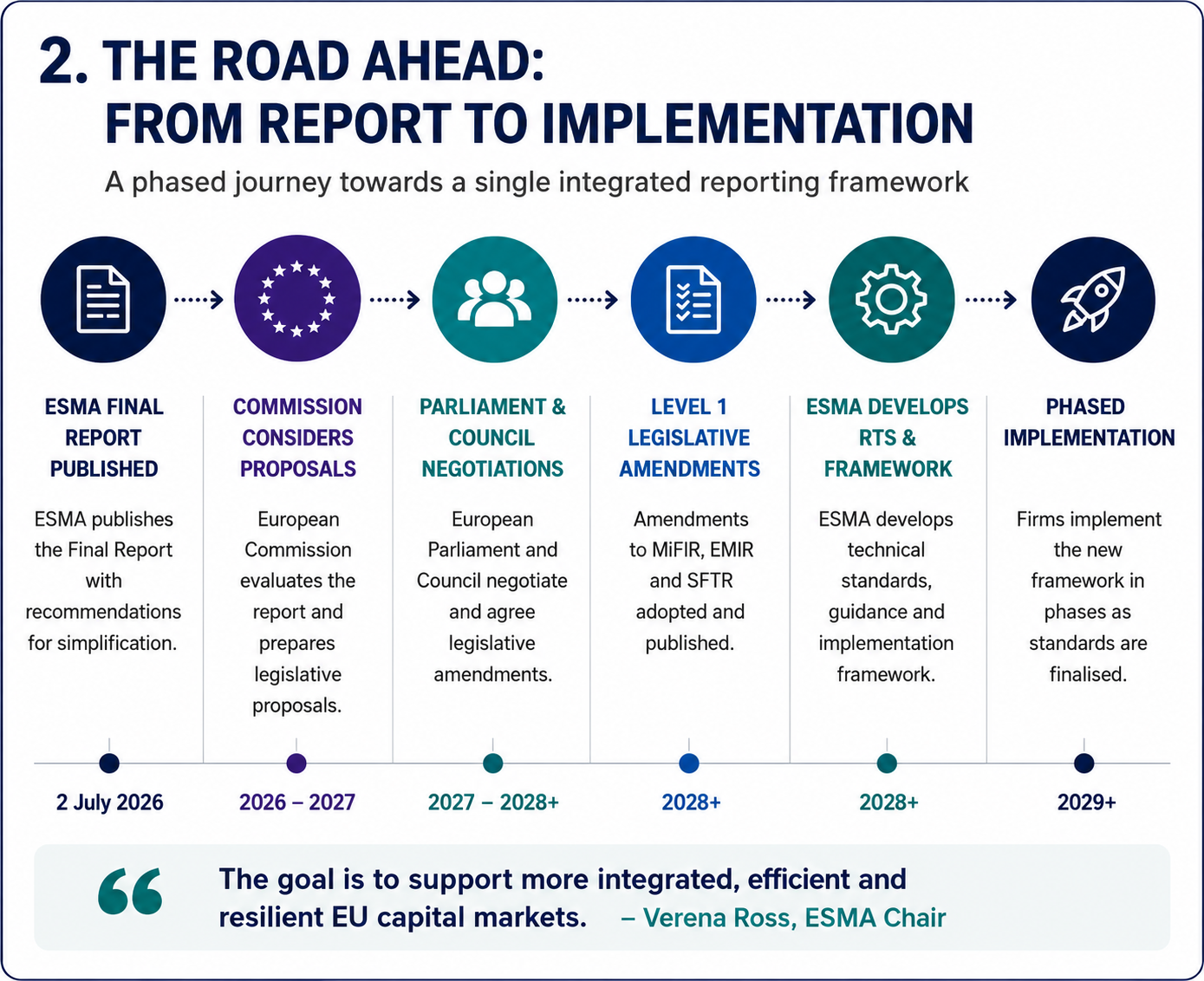
Creating a single reporting framework will require amendments to Level 1 legislation, meaning proposals must first be developed by the European Commission before being negotiated by the European Parliament and the Council. Only then can ESMA begin developing the detailed technical standards needed for implementation.
Recognising that this process will take several years, ESMA also recommends a number of shorter-term improvements that could be introduced sooner, as they do not require Level 1 changes:
- Historical corrections and back-reporting horizon;
- Targeted MIFIR RTS 22 2(5)14 exemptions that are not crucial for market abuse;
- Deprioritising targeted MiFIR RTS 22 and 23 optional fields;
- SFTR reporting of trades for which settlement fails;
- Targeted adjustments to EMIR reconciliation fields;
- Simplification of Errors and Omissions notification framework.
This staged approach allows firms to benefit from incremental simplification while the broader legislative framework develops. Based on ESMA's indicative roadmap, firms would have an estimated 12–18 month implementation period, with the fully integrated reporting framework expected to go live in the second half of 2031.
Who stands to benefit?
While the proposed reforms are expected to deliver significant benefits across the industry, ESMA's analysis indicates that the impact will vary between different types of market participants.
- Buy-side firms - Expected to realise the greatest net benefits, reflecting comparatively lower implementation costs combined with significant reductions in ongoing reporting and operational costs.
- Sell-side firms - While implementation costs are expected to be higher, these are projected to be outweighed over time by meaningful recurring operational savings, resulting in a positive long-term business case.
- Market infrastructures - Likely to experience limited operational savings relative to implementation costs, leading to a marginally negative net financial impact. However, ESMA considers the overall market impact to be limited given the relatively small number of entities in this category.
- Non-financial counterparties (NFC) - ESMA identifies extending and simplifying delegated reporting to include NFC+ entities as a significant opportunity to reduce compliance costs and operational complexity while maintaining the quality of supervisory data.
What should firms be doing now?
Although implementation remains several years away, the Final Report provides an important strategic signal.
Firms making long-term investments in reporting technology, operating models and data governance should begin considering how greater interoperability, common data standards and modular reporting architectures could influence future system design.
This reinforces themes we explored in our article on developing a global transaction reporting strategy. Rather than treating each regulatory change as an isolated project, firms should increasingly focus on building flexible reporting capabilities that can adapt as supervisory frameworks converge.
Those organisations that continue to invest in regime-specific point solutions may ultimately face higher transition costs as reporting becomes more integrated.
Final Thoughts
The Final Report confirms that the direction of travel is no longer speculative. While the legislative process will inevitably take time, ESMA has set out a clear blueprint for the future of transaction reporting in Europe.
Importantly, this is not simply a compliance initiative. It is a data strategy designed to improve supervisory effectiveness while reducing unnecessary operational complexity for firms.
For organisations already modernising their reporting infrastructure, the report provides valuable insight into where future regulatory expectations are heading. Building reporting capabilities around high-quality, reusable data and flexible architectures is likely to prove significantly more sustainable than continuing to optimise individual reporting regimes in isolation.
As we have consistently argued in our earlier analyses, the firms that take a strategic view of regulatory reporting today will be best placed to respond to tomorrow's regulatory landscape.
Qomply will continue to monitor developments as the proposals progress through the European legislative process and will provide further analysis as additional detail emerges.
How Qomply can help
Qomply helps financial firms achieve accurate, compliant transaction reporting across global regulatory regimes, while streamlining the operational and audit demands of regulatory reporting.
Our proprietary technology combines AI, automation and advanced data analytics to deliver scalable, audit-ready reporting intelligence. Through forensic-level quality assurance and streamlined reconciliation, Qomply helps firms strengthen data quality and reporting accuracy, automate controls, simplify audit processes and lower overall reporting costs.
Our technology provides greater oversight and operational efficiency while reducing the demands on internal teams.
For firms seeking to outsource their regulatory reporting operations, Qomply also offers a fully managed service. Combining our technology with deep regulatory expertise, Qomply Managed Services operates as an extension of, or alternative to, an in-house reporting function. This flexible model enables firms to outsource reporting operations while retaining the option to bring activities in-house as their own capabilities and resources evolve.
MiFIR | EMIR | SFTR | CFTC | CSA | MAS | ASIC | HKMA
Frequently asked questions
ESMA’s “Report Once” approach is a proposed integrated transaction reporting framework covering MiFIR, EMIR and SFTR. Firms would report common transaction data once through a shared architecture, with modular extensions used for regime-specific or product-specific requirements.
ESMA has identified several sources of cost and complexity within the current reporting system. These include overlapping obligations, frequent and unsynchronised regulatory changes, duplicate reporting across different frameworks, and dual-sided reporting and reconciliation requirements under EMIR and SFTR.
The proposed long-term framework would integrate transaction reporting requirements across MiFIR, EMIR and SFTR. Common data elements, definitions, identifiers and validation rules would be aligned so that reported information could be reused across regulatory authorities and supervisory mandates.
ESMA’s cost-benefit analysis estimates that an integrated reporting framework could generate between €250 million and €1 billion in annual net savings. It could also reduce recurring reporting costs by approximately 22–24%, with implementation costs potentially recovered within three to four years.
The integrated framework will require changes to EU legislation, followed by the development of detailed technical standards. Based on the indicative roadmap discussed in ESMA’s Final Report, the fully integrated framework could become operational in the second half of 2031, with an estimated implementation period of 12–18 months for firms.
Purpose-built solutions and services for regulatory reporting
Designed to improve accuracy, reduce risk, and support confident transaction reporting.