ESMA’s 2025 Sanctions Report: Key Findings for Reporting Firms
Key Takeaways
- 273 sanctions and measures across three frameworks: ESMA recorded 264 under MiFID II/MiFIR, eight under EMIR and one under SFTR in 2025.
- MiFID II/MiFIR enforcement spanned 24 Member States: Hungary, Italy and Cyprus together accounted for approximately 44% of the measures.
- 2025 marked the first recorded SFTR administrative fine: The report records one administrative sanction under SFTR.
- The figures extend beyond transaction reporting: They cover broader regulatory breaches and should not be presented as reporting penalties alone.
- Submission alone is insufficient: The article highlights accurate, complete and independently validated data, supported by evidence of ongoing oversight.
ESMA's latest enforcement report: 273 administrative sanctions and measures across MiFID II/MiFIR, EMIR and SFTR in 2025.
ESMA's newly published Report on Sanctions and Measures Imposed in Member States in 2025 provides a snapshot of regulatory enforcement activity across Europe.
The report highlights:
- MiFID II / MiFIR: 264 administrative sanctions and measures across 24 Member States. Hungary recorded the highest number (43), followed by Italy (40) and Cyprus (34). Together, these three jurisdictions accounted for approximately 44% of the total.
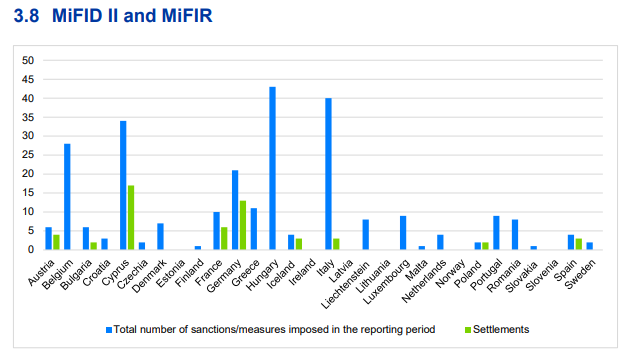
MiFID II/MiFIR sanctions and measures by Member State in 2025.
- EMIR: 8 administrative sanctions and measures across 3 Member States.
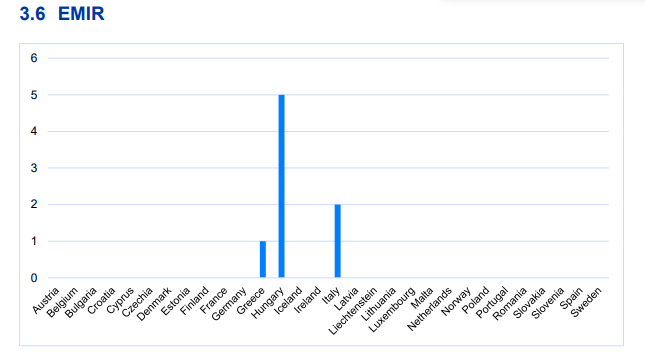
EMIR sanctions and measures by Member State in 2025.
- SFTR: 1 administrative sanction, representing the first recorded SFTR administrative fine.
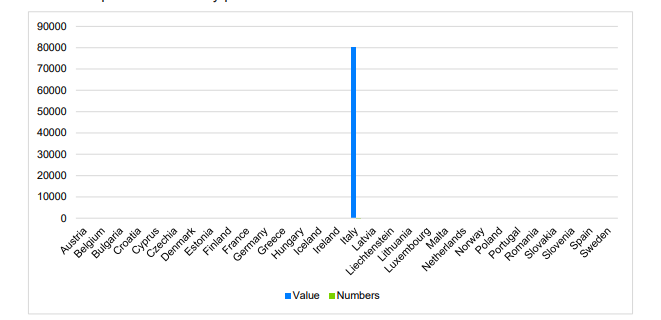
First recorded SFTR administrative fine: €80,000 in Italy in 2025.
An important distinction: These figures reflect enforcement across the broader regulatory frameworks and are not exclusively attributable to transaction reporting breaches.
Nevertheless, the findings reinforce the importance of maintaining robust regulatory controls, effective oversight and demonstrable compliance across reporting obligations.
For firms subject to transaction reporting requirements, the question extends beyond whether reports are being submitted. It is whether the underlying data is accurate, complete and independently validated, with sufficient evidence to demonstrate ongoing oversight.
Regulatory reporting is not simply a submission exercise. It is an ongoing control obligation.
Source: ESMA, Report on Sanctions and Measures Imposed in Member States in 2025 (October 2026).
How Qomply can help
Qomply helps financial firms achieve accurate, compliant transaction reporting across global regulatory regimes, while streamlining the operational and audit demands of regulatory reporting.
Our proprietary technology combines AI, automation and advanced data analytics to deliver scalable, audit-ready reporting intelligence. Through forensic-level quality assurance and streamlined reconciliation, Qomply helps firms strengthen data quality and reporting accuracy, automate controls, simplify audit processes and lower overall reporting costs.
Our technology provides greater oversight and operational efficiency while reducing the demands on internal teams.
For firms seeking to outsource their regulatory reporting operations, Qomply also offers a fully managed service. Combining our technology with deep regulatory expertise, Qomply Managed Services operates as an extension of, or alternative to, an in-house reporting function. This flexible model enables firms to outsource reporting operations while retaining the option to bring activities in-house as their own capabilities and resources evolve.
MiFIR | EMIR | SFTR | CFTC | CSA | MAS | ASIC | HKMA
Frequently asked questions
ESMA’s report records 273 administrative sanctions and measures across these frameworks in 2025: 264 under MiFID II/MiFIR, eight under EMIR and one under SFTR. These figures cover the three selected frameworks.
Hungary recorded the highest number with 43, followed by Italy with 40 and Cyprus with 34. Together, these countries accounted for approximately 44% of the 264 administrative sanctions and measures imposed under MiFID II/MiFIR across 24 Member States.
The report records eight administrative sanctions and measures under EMIR across three Member States. Under SFTR, it records one administrative sanction, representing the first recorded administrative fine under that regulation.
No. The figures cover breaches across the broader MiFID II/MiFIR, EMIR and SFTR frameworks. They should not be described as 273 transaction reporting breaches or 273 fines.
Purpose-built solutions and services for regulatory reporting
Designed to improve accuracy, reduce risk, and support confident transaction reporting.


Diagnostic Auditor | Transaction Reporting Quality Assurance

MiFID Post-Trade | Quality Assurance & Diagnostic Solution

QomplyDirect | Report Directly to the Regulator

Transaction Reporting Managed Services

DualRec | Trade Reconciliations for G20 Regimes

MiFID II Trade Reconciler | Automated Trade Reconciliations