What is MAR 14 Transaction Reporting?
MAR 14 sets out the FCA’s regulatory framework for transaction reporting, establishing the requirements firms must follow when reporting transactions in financial instruments. It supports the FCA’s ability to monitor market activity, identify potential market abuse and maintain the integrity of UK financial markets.
About MAR 14 Transaction Reporting
Transaction reporting has been a core part of the UK’s market oversight framework since the MiFIR transaction reporting requirements were implemented in 2018. Under the current regime, firms report transactions in reportable financial instruments under Article 26 of UK MiFIR, giving the FCA detailed data to monitor financial markets, detect and investigate potential market abuse, and support its supervisory activities.
In August 2026, the FCA published Policy Statement PS26/15, Improving the UK Transaction Reporting Regime, setting out a significant reform of this framework. The reforms are intended to create a more proportionate and streamlined UK transaction reporting regime by simplifying reporting obligations, removing duplicative or low value requirements and improving consistency in how key data fields are populated.
As part of this reform, the FCA is introducing MAR 14: Transaction Reporting, a new chapter of the FCA Handbook setting out the rules and requirements for reporting transactions in reportable financial instruments. MAR 14 will form part of the new UK transaction reporting framework when the revised regime takes effect on 3 April 2028.
Until then, PS26/15 establishes an implementation period during which the FCA is taking a flexible supervisory approach in specified areas. From 3 August 2026, firms can benefit early from certain reforms, including the reduced three year default back reporting period and selected changes to reporting scope and field requirements, while continuing to prepare their systems, controls and reporting processes for the full MAR 14 framework.
When Reporting Goes Wrong
Regulatory reporting failures continue to result in fines, investigations and remediation programmes across multiple jurisdictions.
RECENT ENFORCEMENT ACTIONS:
-
FCA fines Sigma Broking Limited for transaction reporting failures
(Press release, 01 Aug 2025) -
FCA issues first fine for transaction reporting failures under MiFIR
(Press release, 29 Jan 2025)
Avoid the cost of getting it wrong. Get it right first time with Qomply.
Rely On Qomply To Help












Start your
Qomply journey
Related Resources

 Guides
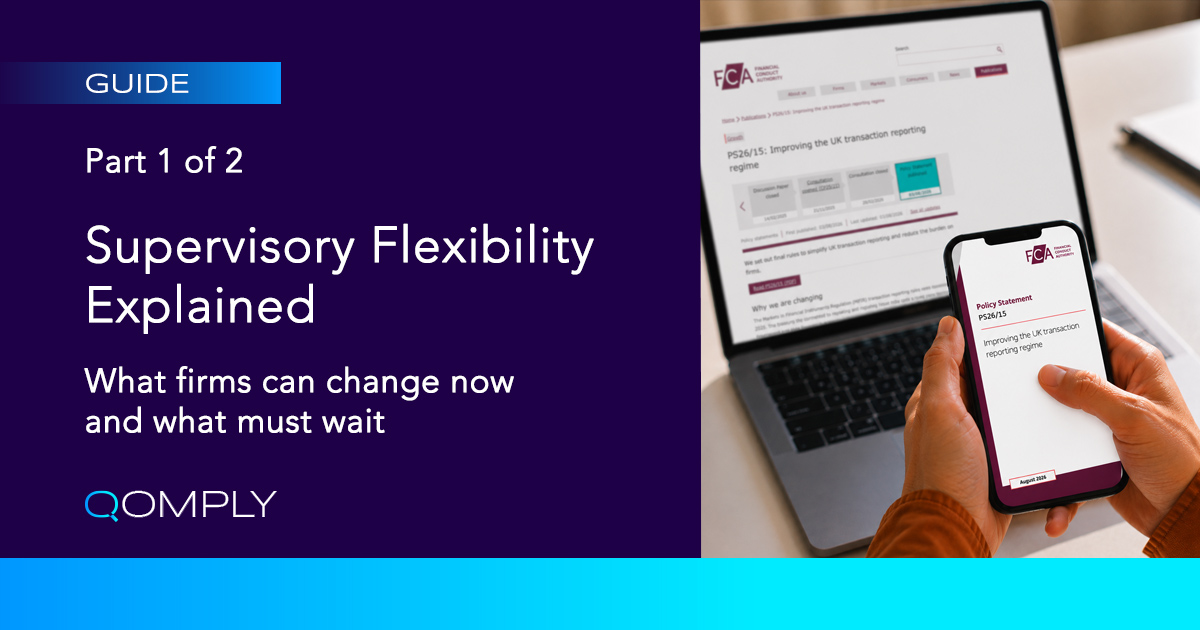
Part 1 of 2 Supervisory Flexibility Explained: What Firms Can Change Now and What Must Wait
 Guides
Part 2 of 2: Supervisory Flexibility Explained: How to Plan for 3 April 2028
 Insights
PS26/15 Is Here: What Firms Should Really Take Away From the FCA’s Final MiFIR Transaction Reporting Reforms
 News
NewsA Front-Row Seat: From the Financial Crisis to the FCA, Nearly 20 Years On.
 Insights
From Submission to Assurance: The Path to Proving Transaction Reporting Accuracy.
 Insights
ESMA's "Report Once" Vision Moves Closer: What the Final Report Means for Transaction Reporting
 Insights
ESMA’s New MiFIR Data Quality Framework
 Guides
Top 5 MiFID II Transaction Reporting Errors (FCA Data 2018-2025)
 Insights
The UK MiFID Rewrite: FCA Predicts Savings. Industry Remains Skeptical
 Videos
Top 5 MiFID II/MiFIR Transaction Reporting Errors
 Guides
MiFID II: Most Common Reporting Issues & How to Mitigate Them
 Guides
MiFID II Guide: The Silent Errors in Your MiFID Transaction Reports
 Guides
Transaction Reporting Cheat Sheet
 Guides
MiFID II Reconciliation 101 Guide
 Videos
What Does a Good MiFID II Transaction Reporting Reconciliation Look Like?
FAQs: MAR 14 Transaction Reporting
MAR 14 is the FCA Handbook chapter that will set out the UK’s revised transaction reporting requirements for firms reporting transactions in financial instruments under the new framework introduced through PS26/15.
The new transaction reporting regime will take effect on 3 April 2028, when firms must comply with the new rules, reporting schema, validation framework and field requirements.
From 3 August 2026, the FCA’s supervisory flexibility allows firms to adopt certain PS26/15 reforms early, including a three year default back reporting period and selected changes to reporting scope and fields.
No. Supervisory flexibility is not a general waiver of transaction reporting obligations and does not allow firms to stop submitting transaction reports across the board.
The new MAR 14 transaction reporting regime takes effect on 3 April 2028. Before then, firms should review the FCA’s new schema and validation rules, assess changes to reporting scope and fields, and update and test their systems and controls.
PS26/15 supervisory flexibility may allow firms to adopt certain reforms early, but firms should continue preparing for full compliance at go live.
Free MiFID Resources
- MiFID Guide: The Silent Errors in Your MiFID Transaction Reports
- MiFID Guide: Transaction Reporting Reconciliation 101
- Free Tool: MDP XML to CSV Converter
- Free Tool: MiFID Reportability Look Up Tool
- Free Tool: Instantly Retrieve Reportable ISINs
- MiFID II: Top 5 Transaction Reporting Error Codes
- Transaction Reporting Cheat Sheet
- MiFID II Deep Dive: Following Market Conventions in the Absence of Prescribed Guidance